
Hendry Release Date Types
A date field has meaning only in its record context. The Hendry County Jail’s public integration shows a booked date and IN or OUT status, but research did not find a public projected-release field or actual release timestamp there. The Hendry Clerk docket may show a sentence, bond order, jail credit, or later order. FDC maintains a different state-prison calculation and uses the public label Current Release Date for an active inmate.
Florida Statute 944.275 calls the projected state calculation a tentative release date. It can move. After release, FDC’s release database or incarceration history may show an actual Release Date. Final discharge from community supervision can occur later still. These labels should not be shortened to one generic “release date.”
| Date or status | Meaning | Best source |
|---|---|---|
| Booked date | When HCSO recorded admission, not a release forecast | HCSO inmate detail |
| Current Release Date | FDC’s present active-inmate projection | FDC population detail |
| Tentative release date | The statutory projection after gain-time changes | Section 944.275 and FDC calculation |
| Maximum sentence expiration | The term endpoint after lawful sentence credit | FDC sentence record |
| Actual Release Date | A completed prison release event | FDC release database or history |
| Supervision discharge | The later end of legal community supervision | FDC, FCOR, or court order |
TO BE SET does not prove that custody ended.Find Hendry Projected Release
Start with the criminal case and current custodian. A person awaiting trial may leave on bond or a new court order, so staff cannot calculate a sentence-based date that does not yet exist. A person serving a county sentence needs the judgment, sentence length, and jail credit from the Hendry Clerk records search, plus confirmation through the HCSO inmate search. Someone committed to FDC should be searched by the six-character DC number in the state network.
- Open HCSO and confirm whether the Hendry record is currently
INorOUT. - Search the Hendry Clerk docket for the judgment, sentence, jail credit, and any later modifying order.
- If the docket shows an FDC commitment, open the official FDC inmate search and match the DC number.
- Copy the date label exactly and note whether it is future, past, or
TO BE SET. - Check for detainers, other sentences, FCOR action, or supervision that may affect the custody path.
- After the projected day, verify actual release through the correct release history or custodian record.
FDC’s offender search menu separates current inmates, inmate releases, supervision, and absconder searches. The active-inmate form accepts name or DC number. Its release-only database includes people already released or scheduled for release and updates nightly, so a user must classify the result by date and status.
Note: FDC excludes ordinary county-jail and county-probation records, so a short Hendry jail case may never appear in its database.
Hendry FDC Release Date
For a person sentenced to Florida state prison, the active FDC detail is the primary public projection. The record may separate identity, current status and location, offense and sentence history, incarceration history, aliases, and an offender image. Verify the DC number and Hendry case reference before relying on the date. Similar names are not enough.
The successful capture below shows the official Current Release Date field and FDC’s warning that release information can change. Identity fields were masked during capture. The image illustrates a field label, not a Hendry County prisoner chosen for any personal characteristic.
View the official FDC active-inmate detail source used for the redacted example.
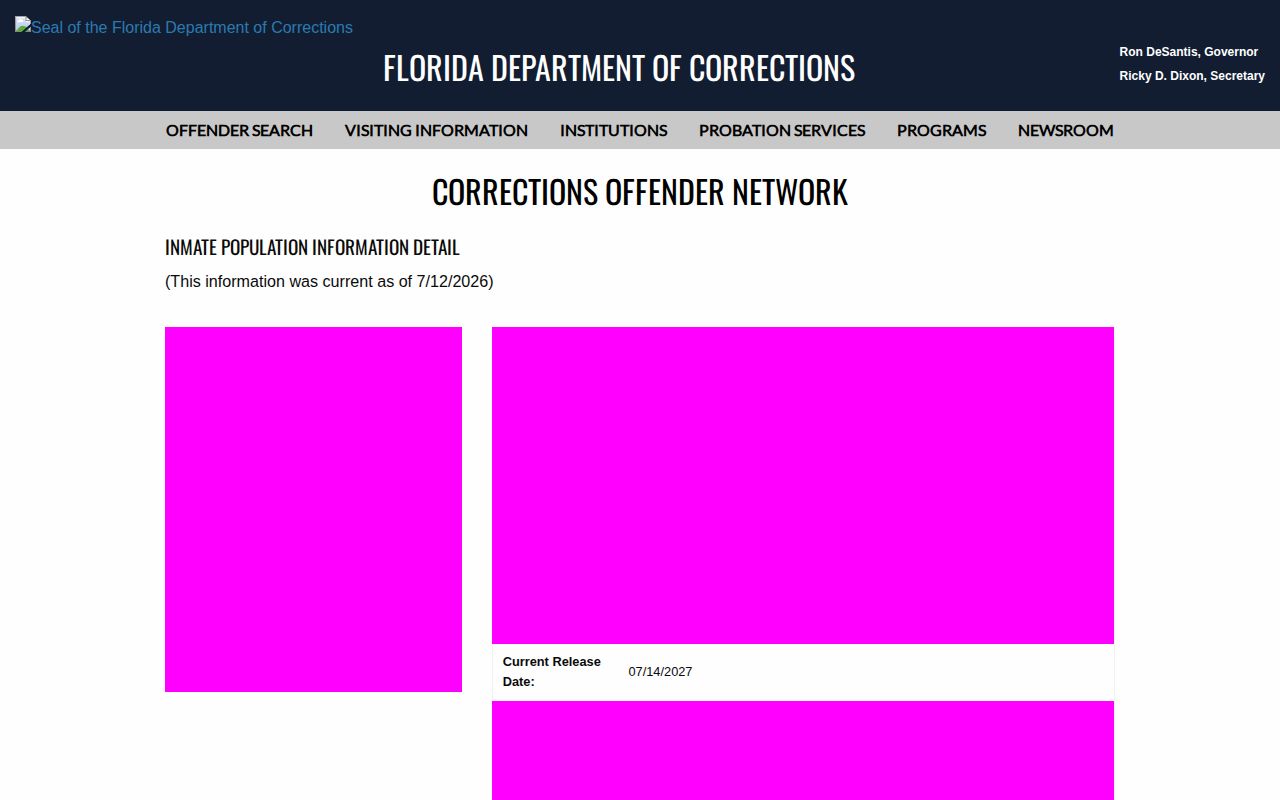
The field demonstrates why the exact public label must be retained and checked again after any gain-time or sentence review.
FDC advises that status, location, and release information can change quickly. Bureau of Classification and Central Records handles accuracy questions at (850) 488-9859. Bureau of Admission and Release handles release questions at (850) 488-9167 or dc.release@fdc.myflorida.com.
Hendry State Gain-Time Rules
Florida Statute 944.275 requires FDC to establish a maximum sentence expiration date for a term of years and a tentative release date based on gain-time granted, restored, or forfeited. Gain-time is a credit administered under the statute. It is not the same as the court’s initial sentence, and it is not automatic in the maximum amount.
For qualifying offenses committed on or after October 1, 1995, incentive gain-time can be awarded up to ten days per month, but it cannot result in serving less than 85 percent of the sentence imposed. Court-awarded time that was physically served counts toward the 85 percent. The familiar 15 percent figure is therefore a maximum possible reduction under the floor, not a promise. Life sentences remain life absent lawful clemency or pardon. The statute also identifies historical cohorts and specified serious offenses committed on or after July 1, 2023 that can be ineligible for incentive gain-time.
Section 921.002(1)(e) reinforces the 85 percent rule for Criminal Punishment Code sentences. Section 921.161 requires the sentencing court to state county-jail credit. A correction to that credit or to the sentence documents can change FDC’s projection.
Read the official tentative-release-date and gain-time statute.
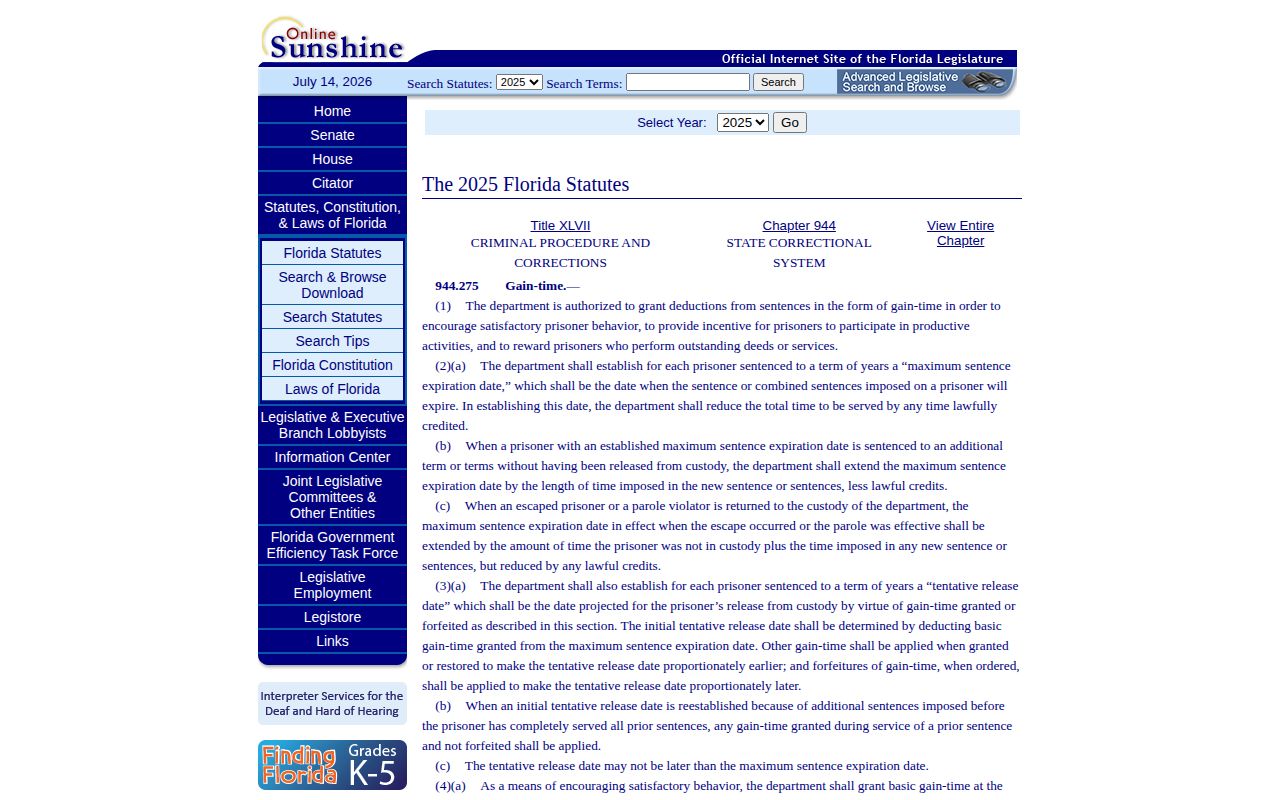
The statute supplies the calculation framework, while the person-level FDC record supplies the current projected result.
Hendry County Gain-Time Rules
County prisoners fall under a different law. Florida Statute 951.21 authorizes county-prisoner gain-time unless the county commission discontinues or revises the policy. The schedule permits up to five days per month in years one and two, ten days per month in years three and four, and fifteen days per month in year five and later. A locally adopted meritorious credit of up to five days per month may also be available on recommendation. Misconduct can cause forfeiture.
No official Hendry County policy confirming use of the statutory maximum was located. That absence is decisive. Do not take a county sentence, subtract the largest figures in Section 951.21, and publish the result as a Hendry release date. Ask HCSO how the sentence and any county credit were recorded, and compare the answer with the Clerk’s judgment and jail-credit entry.
Can an online 85 percent calculator predict a Hendry jail release? No. The state-prison floor, county statute, local policy, sentence structure, and actual credit are different inputs. A generic calculator does not establish any of them.
Note: State-prison gain-time and county-prisoner gain-time come from separate statutes and should never be blended into one estimate.
Changes to Hendry Release Dates
A projected date can move in either direction. Some changes arise from behavior and gain-time administration. Others come from the court record or another custodian. The updated FDC detail or HCSO record should be checked after any material change rather than relying on a saved screen or prior estimate.
| Change | Possible effect | Record to check |
|---|---|---|
| Gain-time award or restoration | May move a tentative date earlier within the law | FDC calculation and history |
| Disciplinary forfeiture | May move a date later | FDC or county custody record |
| Corrected jail credit | Changes credit applied to the sentence | Court order and updated custodian record |
| Concurrent or consecutive terms | Changes how multiple sentences run | Judgment and sentence history |
| Detainer or transfer | May end one custody while another begins | Releasing and receiving agencies |
| FCOR action | May set, change, defer, or condition an eligible release | Final FCOR order and FDC status |
| Pending review | Can leave the date as TO BE SET | FDC and Central Records |
A detainer deserves special care. It is a request or authority for another agency to take or retain custody. HCSO can therefore show a person as OUT even though the person did not enter the community. The release record should identify the public receiving agency when that field is available.
FCOR action applies only to a legally eligible release path. A commission agenda is a schedule, not an outcome, and a favorable action can still require a lawful release plan or resolution of a detainer. Read the final order, then compare it with the current FDC date and status. This keeps the commission decision, prison projection, and physical release event in the right sequence.
Hendry Pretrial Release Timing
A person held before disposition does not have an FDC sentence date to calculate. Release may depend on a bond, recognizance order, pretrial-services placement, dismissal, plea, or later court action. The HCSO inmate detail can show a bond amount when supplied, but an amount does not prove that bond was posted. Staff also may not be able to predict when a judge will sign or modify an order.
Use the Hendry Clerk’s criminal docket to locate the bond or release order and read later entries in sequence. Felony matters proceed in Circuit Court, while County Court handles misdemeanors and criminal traffic cases. The online CiviTek record is informational, not authoritative. Obtain the order when its exact terms matter, then confirm physical custody movement with HCSO.
Once the person changes to OUT, the HCSO status supports that the county jail no longer holds the person at the time reflected. It still does not say whether the event was community release, FDC commitment, ICE transfer, or movement to another jail.
Confirm Hendry Actual Release
Return to the custodian after the projected day. For FDC, use the release database and look for an actual historical Release Date, incarceration-history out event, and current status. If community supervision is active, the person left prison but has not reached final discharge. A future record in the release database remains scheduled, even though the database includes both released and scheduled populations.
For HCSO, confirm OUT, check the Hendry Clerk order, and use the official HCSO records gateway when the exact time and reason matter. The request should name the person, inmate ID and booking date, and ask for actual release date and time, release disposition, and public transfer or receiving-agency notation. The full county search path is available on the Hendry released-inmates home page.
Record the check time and keep each source label. A historical FDC release date can coexist with a later jail booking, and a county OUT event can coexist with a new state or federal custody. A date is reliable only for the custodian and event it describes.
VINE can add a status alert while the event is pending. Registration and system limits are explained on the Hendry VINE inmate check. A notice should still be compared with the record-owning agency.
Note: Preserve both the projected field and later actual field when documenting how the date changed over time.