
FDC Hendry Release Coverage
The Florida Department of Corrections is a statewide system, not a jail building in Hendry County. A person enters its public Corrections Offender Network after a qualifying state prison sentence or state supervision case reaches FDC. The assigned six-character DC number follows that record even when the person moves between institutions. After prison release, FDC can preserve incarceration history, sentence data, an actual release date, a photograph, and active community-supervision information.
Coverage has a firm boundary. FDC expressly excludes people sentenced only to county jail, county probation, or other non-FDC supervision. A short HCSO booking can change to OUT without ever appearing in FDC. Conversely, disappearance from the Hendry jail after commitment to FDC is not community release. It means the state system is now the correct custodian. No active FDC prison was located in Hendry County during the facility sweep, but Hendry cases remain searchable statewide.
| Custody path | Correct source |
|---|---|
| Hendry county-jail release | HCSO release record and Clerk docket |
| Florida state-prison release | FDC release search and offender detail |
| State community supervision | FDC supervised-population record and field office |
| Federal sentence | BOP Inmate Locator, not FDC |
Find FDC Hendry Releases
Open the FDC offender-search menu and choose the database that fits the question. The release-first route is Inmate Release Information Search. FDC says it contains people already released or scheduled for release and updates nightly. Therefore, finding a person in that database does not alone prove the event has happened. Compare the displayed date with the current date and read the current status and incarceration history.
Search by the six-character DC number when possible. It is the best way to distinguish people with similar names. The form also accepts last name and first name, supports alias searching, and uses beginning-of-name matching. Photo options alter list presentation rather than the underlying person record. Open the detail, confirm the committed name and DC number, and copy each date label exactly.
- Select the release, all-offender, inmate, or supervision database that fits the custody question.
- Enter the DC number, or use name fields and aliases.
- Open the matching detail and verify identifiers.
- Separate a future scheduled date from a past actual release.
- Read current status, incarceration history, sentence history, and supervision information together.
- Contact FDC Central Records when a field appears wrong or unclear.
Important: A future record in the release database is scheduled information, not proof that prison custody has ended.
FDC Release Search Fields
The FDC inmate-release search provides the dedicated route for released or scheduled-to-be-released state prisoners.
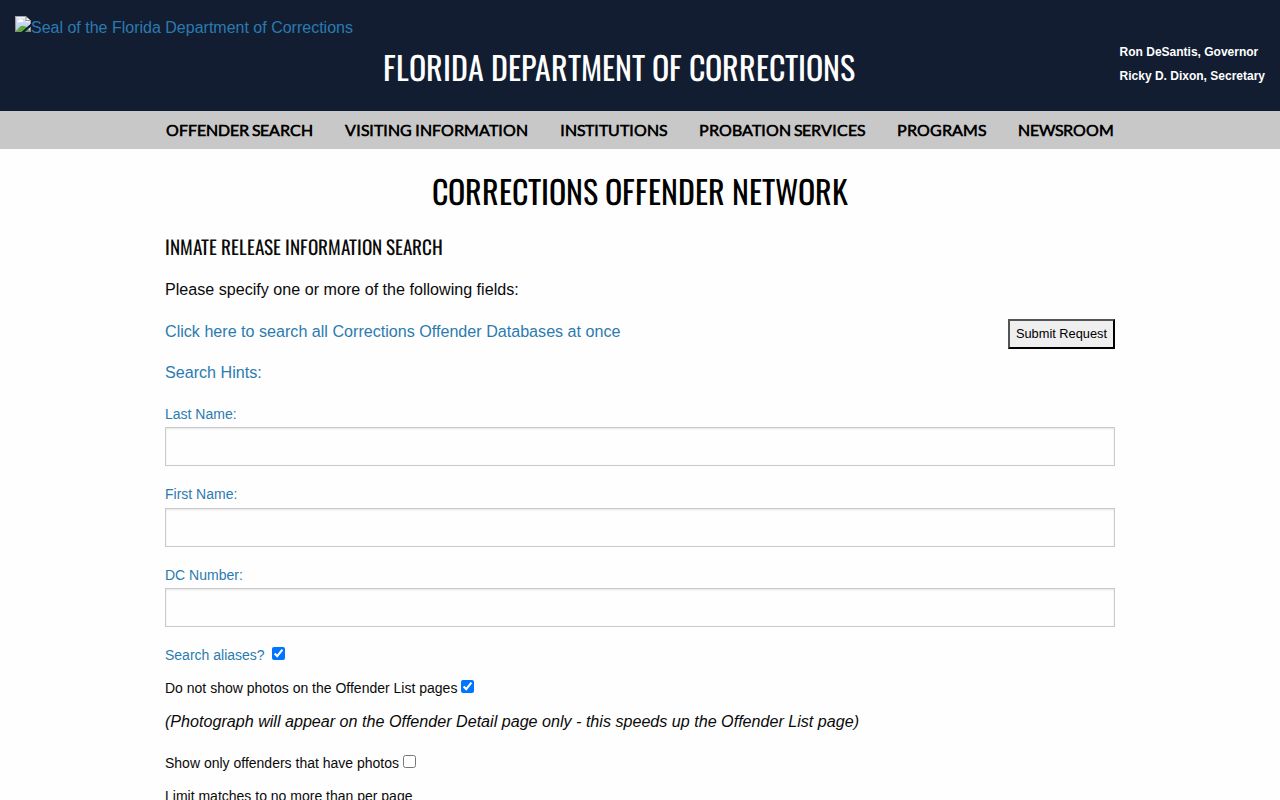
The source's nightly update statement and search filters help classify the result, but the person detail remains necessary for the actual status and history.
A release detail can show a photograph, DC number, committed name, descriptors, actual Release Date, release facility, public residence information or a supervision link, sentence and offense history, county and case number, detainers, and incarceration in-and-out dates. The record may prove a past release through the database category, date, and out event without using one broad discharged badge.
| Field | How to read it |
|---|---|
| Release Date | Historical date in a released-person record |
| Current Release Date | Changeable projection for a person still incarcerated |
| Current status/location | Whether FDC reports prison, supervision, or inactive status |
| Incarceration history | Admissions, movements, and out events |
| Supervision link | Possible legal control after prison exit |
| Detainer | Another custody interest that may affect destination |
FDC Projected Versus Released
Florida terminology distinguishes a planned date from a completed event. A live inmate detail uses the label Current Release Date and warns that it can change through gain-time awards, forfeitures, or review. Florida Statute § 944.275 calls the governing calculation the tentative release date. That is the date projected because of gain-time granted or forfeited, and it differs from the maximum sentence expiration date.
The value TO BE SET means review is pending. It does not mean a zero sentence or immediate release. Sentence paperwork, corrected jail credit, concurrent or consecutive structure, gain-time changes, disciplinary action, a detainer, or a commission decision can alter the projection. After the event, move from the active-inmate projection to the release database and historical out record. An actual prison exit may begin probation, parole, conditional release, or another form of supervision rather than end all legal control.
- Tentative release date
- The statutory, changeable projection affected by gain-time.
- Release date
- The historical date attached to the completed prison out event.
- Discharge
- The end of the applicable sentence or supervision obligation, which may occur after prison release.
- Detainer
- Another agency's custody claim or notice that can change the destination.
Keep the exact FDC wording. A released or inactive status does not mean that a conviction vanished, a sentence was erased, or every related case ended.
FDC Hendry Release Records
The public offender network is a search tool, not a certified record service. For a formal state-prison release record, identify the DC number and contact the FDC public-records office. Ask for the inmate record, release date, release type, public movement or release documentation, and photograph, subject to lawful redaction. FDC's portal provides a trackable request route and a cost estimate after exemption review.
The records office source is shown below because it is the proper fallback when a public search field is missing or needs official context.
The records route complements the offender detail. It does not turn an active projection into an actual release.
Florida Department of Corrections
501 South Calhoun Street
Tallahassee, FL 32399-2500
General: (850) 488-7052
Classification and Central Records: (850) 488-9859
Bureau of Admission and Release: (850) 488-9167, dc.release@fdc.myflorida.com
Public-record assistance: (850) 717-9774
Use the DC number in every contact. For a data-accuracy issue, Central Records is the direct line published by the search. For a release question, the Bureau of Admission and Release is the more specific channel.
FDC Supervision After Release
Leaving an FDC prison and leaving FDC control are different events. The offender detail can point to active probation, parole, conditional release, or a related supervised status. In that situation the person is outside prison while still subject to legal conditions. Search the supervised-population database and verify the DC number, status type, and field-office information. Same-day questions belong with the displayed or geographically appropriate FDC field office.
Florida parole is limited. The state abolished parole eligibility for most offenses committed on or after October 1, 1983, though older and specially eligible sentence structures remain. The Florida Commission on Offender Review handles parole and specified release decisions, while FDC performs most community supervision. A commission agenda shows scheduled action, not a guaranteed release. Preserve the agency's exact terms and check the final order when the result matters.
Hendry County pretrial services is separate. A person released by the local court while a case is pending may report to that program without any FDC record. County probation is also outside the FDC offender-search coverage identified by the agency. The court case number and Hendry Clerk docket are the proper route for those local orders.
Former Hendry Prison Searches
Old records may name Hendry Correctional Institution. That institution closed in the state's 2012 closure round and is absent from the current FDC institution directory. It is not a place to call for a current release. Search the former prisoner by DC number or name in the statewide offender network, then request central records if the public detail is incomplete.
This history prevents two common errors. First, the former prison should not be confused with the active Hendry County Jail on Bridge Street. Second, a person with a Hendry County case could have served time at any FDC institution, so the institution name is less durable than the DC number. The statewide person record, not a closed building, preserves the useful release trail.
Remember: FDC records cover state prison and state supervision, while HCSO records cover the Hendry county jail.
FDC Hendry Update Timing
FDC publishes different update rhythms for its data. The release database updates nightly. Population information refreshes weekly except release dates and location changes, which update nightly. These schedules can explain why a same-day event does not align across every view. Preserve the check time and contact Central Records when a current location or date needs direct review.
The person detail can include county and case number, stated residence upon release when public, and detainer information. Those fields connect the statewide record to a Hendry sentence without turning FDC into a county roster. A photograph in the FDC detail is a state offender image and may not be the photograph made during a Hendry booking.
When FDC does not fit the case, return to the local creator. The HCSO inmate search checks Hendry jail custody, the HCSO records gateway accepts a request for the release or transfer report, and the Hendry Clerk records gateway can identify the sentencing or commitment order. Together they show whether the person stayed in the county system or entered FDC.